Showing posts with label making a graphic novel. Show all posts

Wednesday, August 31, 2011

1000 Things To Learn, #3: Uploading Images To The Internet Without Losing Color Fidelity

Warning!  Bunch of technical stuff follows.  May not be for everyone.  Skip down to the last post to get to a Chandra page.

As I broke it down in THIS POST, I'd been uploading images to this website with an incorrect color profile.  I was wondering why they were looking so washed out and ragged.  Well, it turns out that you have to really pay attention to the 'color space' of the file in Photoshop and then in the internet.  The analogy used is that of a box of crayons, the internet has a smaller box than Photoshop, so you have to be very specific with what colors you tell it to use.  LUCKILY this is an easy fix.

The Dark Knight in an Unsaturated Nightmare...and Restored!
Some websites seem to adapt the file automatically (smartly), others, like Blogger, don't.  Also, it should be borne in mind that the large thumbnail images that are created for a graphic file are always washed out a certain amount.  I can't seem to figure out how to affect that.

Color is a really tricky business and I know when it comes time to actually make a graphic novel, meaning, print one up, there will be a whole host of new headaches.  But for now, let's limit ourselves to uploading properly.

Continued after the break.

Thursday, August 18, 2011

1000 Things To Learn, #2: The Curriculum, Part 1

I previously enumerated the different branches of what I'm calling The Curriculum, HERE.  I thought I'd take a moment to list these things out in greater detail.  The Curriculum is what, in my estimation, it takes to become successful at making a graphic novel.  At least, I think so.  These seem to be the things that need to be focused on to get where I want to be.  These items are listed in order of their chronological place in the actual creation of a graphic story.  I'll be dissecting each of these in greater depth in future posts.  Am I rambling?  Here are numbers 1 - 6.  Let's see if this makes sense:

Scripting - This is where it all starts.  You need a story before you draw a damn thing and you've got to write that story convincingly.  What's one of the best ways to learn to write convincingly?  By reading.  Read as much as you can, not just Graphic novels and comics, read everything you can get your hands on.

Art Direction - What is the ultimate look of the final product?  Will it have a solid Jack Kirby spin to it or are you going for the fluid line of Yoshitaka Amano?  Gather your influences about yourself and distill them down into the important elements that you want to visually represent.

 The sensual feel of Yoshitaka Amano

Anatomy - This is a bit of an outlier.  Anatomy is something you should be working on ALL THE TIME.  Even if you're ultimately cartooning.  Draw from life, draw from photos, draw from statues.  Learn how muscles and bone fit together.  Learn where fat gathers.  The comic artist David Finch says he drew every page in Bridgman's Drawing From Life three times and then did it again with the book closed.  I can't think of a much better task to set for oneself.

Character Design - At this point you probably already have a pretty good idea what your characters will look like.  Here is where your project will really start to come to life though.  Draw those characters in different clothing, with different expressions.  Go wild at this point as you try to nail down what exactly this person or creature will look like.  When you have designs that you're happy with then it's time to draw what are called Turnarounds.  That is, draw them from the front, back and at least one side, focusing on the continuity of the character.

Thumbnails - Here begins the visualization of your project.  The more you include in this step, the better time you'll have later on.  They say: "More time on the front end, means less time on the back end."  Or if you want to go old wives': "A stitch in time saves nine."  What I mean is you should get as much detail and direction into your thumbnails as possible.  Include lighting direction and placement of word bubbles, everything.

Cartooning - This is something that manga artists really excel at.  Sometimes, being that comics are a static medium, you need to really ramp up the emotion.  Rather than just simply making the text in the word balloon bold and adding exclamation points, you might need to tweak the features and emotions of the character.  It can come in handy to have the confidence to step outside reality sometimes.

My goal over the past few weeks has been to buckle down on this curriculum as hard as possible, studying and practicing the different items on the list whenever I have spare time.  Feeling adventurous, like you want to hone your own chops?  Join me!
Stay tuned for number 7 - 12 next week.

Monday, August 8, 2011

1000 Things To Learn, #1: (Try To) Draw Every Day

You know how they tell kids who want to play basketball for a living to take a basketball with them everywhere?  They should be sleeping with that basketball.  You have to get a feel for it in your hands, the space it occupies next to you, how it moves when you dribble it.  It's the same with drawing.  I take a sketchbook with me where ever I go.  In fact, I'm a junkie for sketchbooks.  I have moleskin's tucked into the glovebox in my car.  Sketchbook on the coffee table, another by my computer.  One there under my bed.  I'm drowning in the damn things.  They might not ever get all filled up but the important thing is that when I have an idea it's written down or even better, drawn.
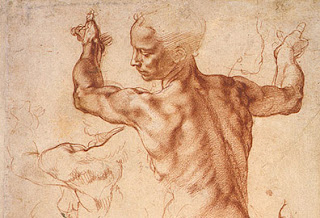
Michelangelo's Sensitive Line and Expert Rendering

You have to draw every day.  You're waiting in the doctor's office?  Don't pull out your phone.  That's a time sink.  Get that sketch book out and draw the fake ficus in the corner.  Draw from life as much as possible.  And then draw from your imagination twice as much.  Dry to envision something random and draw it, exactly as it appears in your mind.

When I was studying painting in Italy our first task was the old cast drawing gag.  We weren't supposed to touch a paint brush until we'd been drawing plaster replicas of classical sculpture in charcoal for at least one year.  That's four hours a day, every week day, working on a single drawing for at least a week, sometimes as much as three.  Those unfamiliar with drawing from busts and other plaster models don't know what they're missing.  It's tedious but it teaches your eye to really see.  It sharpens your edge so you're attuned to proportion like nothing else.

BUT, the point is not cast drawing.  That's a worthy exercise, but it only gets you so far.  We're talking about the sketchbook here.  Whip that thing out and spin your ideas, copy from magazines, get friends to sit for you, draw that sleeping dog over there.  Become sensitive to line and mass.  Those two elements are the groundwork for anything you'd build on the page.  Those are the visual components, but they are informed by your honed understanding of proportion, perspective, volume and light. 

Anyway, this all brings us to what I'm calling THE CURRICULUM.  I've set myself a series of twelve areas of study to become an effective creator of Graphic Novels, webcomics, what have you, and they are these:

1] Scripting
2] Art Direction
3] Visualization
4] Anatomy
5] Character Design
6] Cartooning
7] Drawing
8] Interiors/Objects
9] Inking
10] Ink Wash
11] Watercolor
12] Digital Coloring

Now, each of these categories contains subgroups that I won't go into now as I have more in-depth write-ups planned for each, but these are the major building blocks I've identified that are important to master when creating a graphic novel.  I feel I'm experienced in a number of these, while others are severely lacking at the moment.  BUT, from this list, I'm setting tasks for myself which I will detail here.  Those aspiring creators out there are welcome to join me and also, suggest things I may have left off the list. 

Before I go, I'm highly, highly recommending a book for anyone who calls themselves an artist.  It's Harold Speed's Practice and Science of Drawing, and it is phenomenal.  Though it was written in the late 19th or early 20th century it contains none of that stuffy, antiquated language.  It's remarkably fresh and easy to digest and even if you don't draw, it will make you want to.